Fastest MS SQL Inserts — Part 8: TVP, JDBC, Final Ranking
Executive Summary
This series benchmarks 110+ insert strategies and tuning knobs on SQL Server 2025 Express (Windows, Java 17, Spring Boot 3.3) over 4,222 individual benchmark runs. Here's the TL;DR:
The 10 highest-impact decisions (in order)
| # | Choice | Impact |
|---|---|---|
| 1 | Batch your inserts (any strategy ≫ auto-commit per row) | 15x |
| 2 | Use the Bulk Copy API (SQLServerBulkCopy / insertBulk...) | 5-6x vs plain JDBC |
| 3 | Parallelize across 4 connections | 2-3x on top of #2 |
| 4 | Enable useBulkCopyForBatchInsert=true in the JDBC URL | 2-2.5x |
| 5 | Use multi-value INSERT (200 values/statement) | 4-5x for JDBC |
| 6 | Drop/disable non-essential indexes before bulk loads | up to 7x |
| 7 | Pick the right batch size (500-1000) — not 10, not 10,000 | 4-5x vs tiny batches |
| 8 | Add WITH (TABLOCK) hint for dedicated bulk-load windows | 1.3x |
| 9 | Use Persistable + isNew=true if you must use Spring Data saveAll | 8x |
| 10 | Keep AUTO_UPDATE_STATISTICS = ON (don't try to be clever) | 1.5x |
Top 7 counter-intuitive findings
OPTION (RECOMPILE)makes batched inserts 52x slower (2.4 minutes vs 3 seconds).- Delayed Durability
= FORCEDmakes bulk inserts 49% SLOWER, not faster. It helps many-small-commits workloads, not single-large-transaction bulk loads. - Natively compiled stored procs are 21x slower when called from Java per-row via
addBatch. Their design assumes the C#/.NET memory-table API. - In-Memory OLTP tables don't help batched Java inserts. They shine for concurrency, not batch throughput.
- ROW/PAGE compression make inserts slower (+7%/+33%). Compression is a read optimization.
- BCP utility is slower than Java Bulk API when data is in-memory. The file I/O overhead dominates.
- AUTO_UPDATE_STATISTICS = OFF makes inserts 50% SLOWER, not faster. The optimizer needs stats even for simple INSERTs.
The absolute fastest paths (if your scenario allows)
If your source data is already in SQL Server (ETL within the same database):
INSERT INTO target SELECT ... FROM source= 319 ms (the ultimate server-side copy)
If data must come from Java:
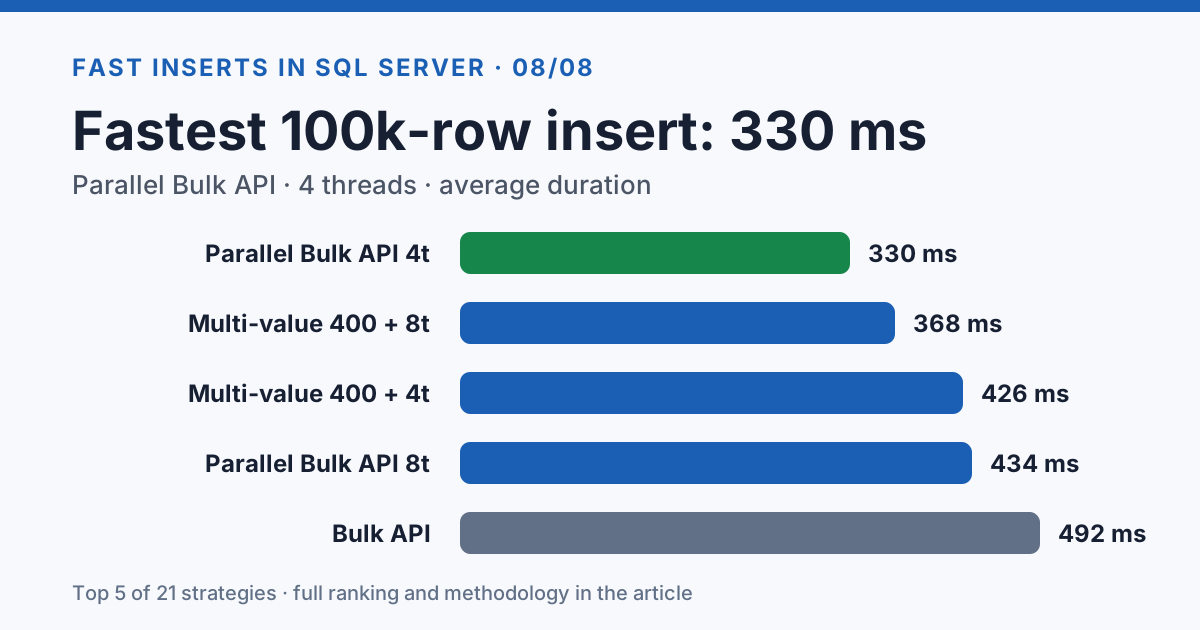
- Parallel Bulk API 4 threads = 330 ms (the standalone Java winner)
The ranking
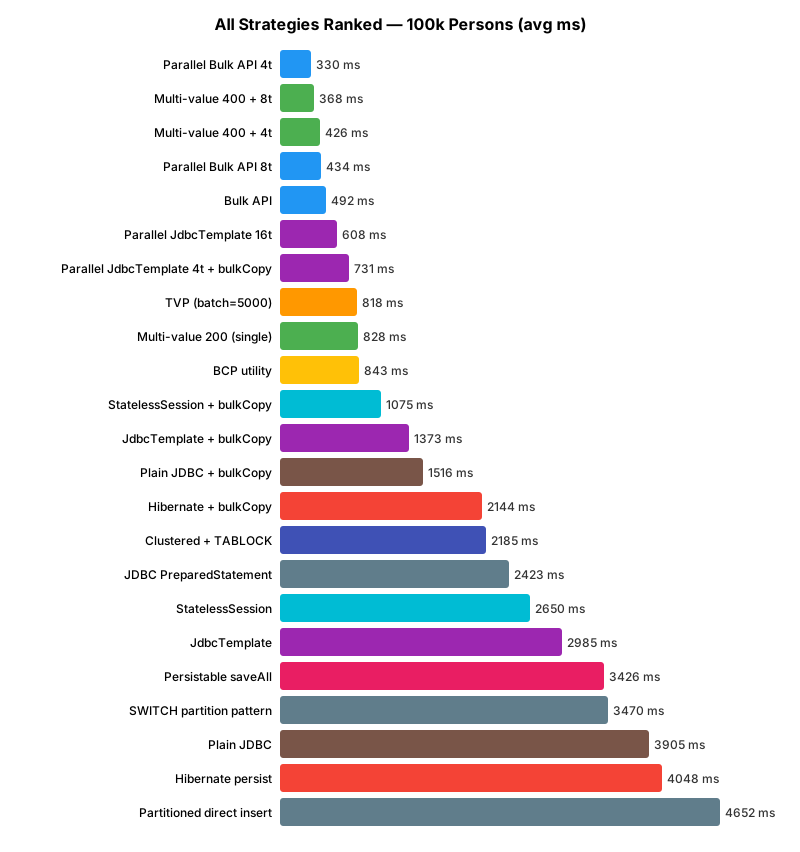
The fastest I could get 100,000 person rows into SQL Server from a Java application is
330 ms (Parallel Bulk API, 4 threads). The slowest is 27,794 ms (Spring Data saveAll
without Persistable) — 84x slower. Everything in between is covered in this series.
TVP (818 ms) is the best choice when you need portability across different clients and don't
have SQLServerBulkCopy available. Plain JDBC (3,905 ms) is only 3% faster than Hibernate
persist() — the ORM is not your bottleneck.
The rest of this post walks through every topic in the summary above, starting with two approaches that bypass Hibernate entirely: Table-Valued Parameters and plain JDBC. After that come the advanced topics — isolation, procs, plans, latency, snapshot concurrency, index trade-offs, and the full ranking across 110+ configurations.
Table-Valued Parameters (TVPs)
TVPs let you send an entire table of data as a single stored procedure or query parameter. Instead of sending N individual INSERT statements, you send one request containing all the data.
Setup: Create the Table Type
First, create a user-defined table type in SQL Server:
1CREATE TYPE dbo.PersonTableType AS TABLE (
2    person_id INT,
3    user_name NVARCHAR(30),
4    first_name NVARCHAR(10),
5    last_name NVARCHAR(15),
6    years INT
7);
Java Implementation
The MS SQL JDBC driver provides SQLServerDataTable for building TVP data:
 1@Repository
 2public class TvpInsertRepository {
 3    private final DataSource dataSource;
 4
 5    public void insertWithTvp(List<Person> people, int batchSize) {
 6        String sql = "INSERT INTO person (person_id, user_name, first_name, last_name, years) " +
 7                     "SELECT person_id, user_name, first_name, last_name, years FROM ?";
 8
 9        try (Connection conn = dataSource.getConnection()) {
10            conn.setAutoCommit(false);
11
12            try (CallableStatement stmt = conn.prepareCall(sql)) {
13                for (int i = 0; i < people.size(); i += batchSize) {
14                    int end = Math.min(i + batchSize, people.size());
15                    SQLServerDataTable dataTable = buildDataTable(people.subList(i, end));
16                    stmt.setObject(1, dataTable);
17                    stmt.execute();
18                }
19                conn.commit();
20            }
21        }
22    }
23
24    private SQLServerDataTable buildDataTable(List<Person> people) throws SQLException {
25        SQLServerDataTable dt = new SQLServerDataTable();
26        dt.setTvpName("PersonTableType");
27        dt.addColumnMetadata("person_id", Types.INTEGER);
28        dt.addColumnMetadata("user_name", Types.NVARCHAR);
29        dt.addColumnMetadata("first_name", Types.NVARCHAR);
30        dt.addColumnMetadata("last_name", Types.NVARCHAR);
31        dt.addColumnMetadata("years", Types.INTEGER);
32
33        for (Person p : people) {
34            dt.addRow(p.getPersonId(), p.getUserName(),
35                      p.getFirstName(), p.getLastName(), p.getYears());
36        }
37        return dt;
38    }
39}
TVP Advantages
- Single round-trip per batch — the entire data table is sent as one TDS packet
- No 2,100-parameter limit — unlike multi-value INSERT which hits SQL Server's max param count
- Type-safe — SQL Server validates the table type schema
- Works inside transactions — unlike
BULK INSERTfrom a file
TVP Results
| Batch Size | Avg ms |
|---|---|
| 10 | 20,221 |
| 100 | 2,993 |
| 1,000 | 1,203 |
| 5,000 | 818 |
TVP at batch=5000 (818ms) is the 3rd fastest single-thread strategy — faster than all JDBC/Hibernate approaches, slower only than Bulk API. It's a solid middle ground.
Plain JDBC: The Bare-Metal Baseline
How much overhead does Hibernate/JPA actually add? Let's find out with raw JDBC:
 1@Repository
 2public class PlainJdbcInsertRepository {
 3    private final DataSource dataSource;
 4    private static final String INSERT_SQL =
 5        "INSERT INTO person (person_id, user_name, first_name, last_name, years) " +
 6        "VALUES (?, ?, ?, ?, ?)";
 7
 8    public void insertBatch(List<Person> people, int batchSize) {
 9        try (Connection conn = dataSource.getConnection()) {
10            conn.setAutoCommit(false);
11            try (PreparedStatement ps = conn.prepareStatement(INSERT_SQL)) {
12                int count = 0;
13                for (Person p : people) {
14                    ps.setInt(1, p.getPersonId());
15                    ps.setString(2, p.getUserName());
16                    ps.setString(3, p.getFirstName());
17                    ps.setString(4, p.getLastName());
18                    ps.setInt(5, p.getYears());
19                    ps.addBatch();
20                    if (++count % batchSize == 0) ps.executeBatch();
21                }
22                if (count % batchSize != 0) ps.executeBatch();
23                conn.commit();
24            }
25        }
26    }
27}
The Surprising Result
| Strategy | 100k persons (avg ms) |
|---|---|
| Plain JDBC | 3,905 |
| Hibernate persist | 4,048 |
| JdbcTemplate | 2,985 |
| StatelessSession | 2,650 |
Plain JDBC (3,905ms) is only 3% faster than Hibernate persist (4,048ms). The ORM overhead for batch inserts is negligible. Most of the time is spent in JDBC driver wire protocol and SQL Server's INSERT execution, not in Hibernate's entity management.
JdbcTemplate is actually faster than plain JDBC because Spring's JdbcTemplate.batchUpdate()
uses optimized batch parameter binding that the JDBC driver can optimize further.
With useBulkCopyForBatchInsert=true
| Strategy | Normal | bulkCopy=true | Speedup |
|---|---|---|---|
| Plain JDBC | 3,905 | 1,516 | 2.6x |
| JdbcTemplate | 3,089 | 1,373 | 2.3x |
| StatelessSession | 2,650 | 1,075 | 2.5x |
| Hibernate persist | 4,048 | 2,144 | 1.9x |
With bulkCopy=true, all JDBC-based strategies converge to similar performance. The driver's bulk
copy conversion is the dominant factor, not the Java-side abstraction.
Multi-Value INSERT and bulkCopy Don't Mix
During testing, we discovered that multi-value INSERT (objectsPerInsert > 1) is
incompatible with useBulkCopyForBatchInsert=true. When this driver flag is enabled, it
rewrites PreparedStatement.addBatch() calls into Bulk Copy protocol — but it expects single-row
INSERT statements with exactly (columns) parameters per batch entry. Multi-value INSERT SQL
(VALUES (?,?,?),(?,?,?),(?,?,?)...) confuses the driver because it has (columns * N) parameters.
This means you must choose one or the other:
- Multi-value INSERT (400 values/statement) — works only with
bulkCopy=false - useBulkCopyForBatchInsert=true — works only with single-row INSERT statements
Both are excellent optimizations, but they cannot be combined.
Isolation, MERGE, Triggers & Async
Snapshot isolation (READ_COMMITTED_SNAPSHOT)
RCSI changes READ_COMMITTED to use row versioning instead of shared locks for reads. It prevents
reader-writer blocking at the cost of version store overhead:
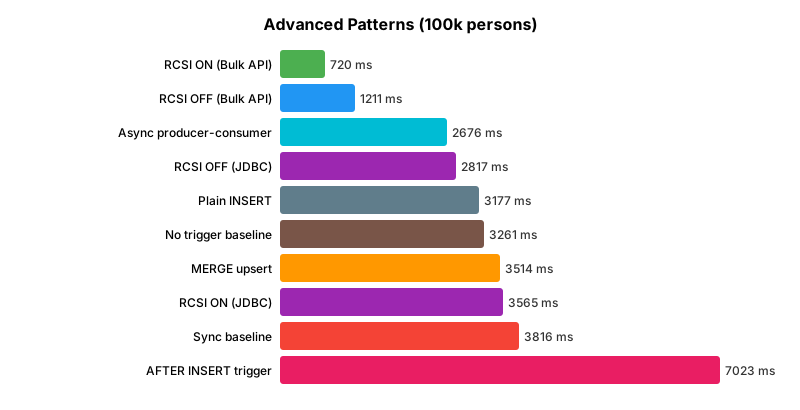
| Strategy | RCSI OFF | RCSI ON | Delta |
|---|---|---|---|
| Bulk API | 1,211 | 720 | 40% faster |
| JdbcTemplate | 2,817 | 3,565 | 27% slower |
Surprise: RCSI dramatically helps Bulk API (fewer latches/lock contention on data pages) but hurts JdbcTemplate (row versioning writes to tempdb). Enable RCSI if you're bulk-loading with the Bulk Copy protocol and have concurrent readers.
MERGE vs plain INSERT
MERGE INTO ... USING (VALUES) WHEN MATCHED THEN UPDATE WHEN NOT MATCHED THEN INSERT is the
canonical SQL upsert. How much does the upsert semantics cost?
| Method | 100k rows (avg ms) |
|---|---|
| Plain INSERT | 3,177 |
| MERGE upsert | 3,514 (+11%) |
The 11% overhead is the cost of the ON clause evaluation and the branching logic. For pure inserts, use INSERT. For true upserts (where some rows may already exist), MERGE is cleaner than a SELECT-then-INSERT/UPDATE pattern.
Warning: MERGE has known bugs with concurrent executions on SQL Server. Many SQL Server MVPs
recommend INSERT ... ON EXISTING UPDATE or explicit IF EXISTS patterns in production code.
Trigger overhead
A single AFTER INSERT trigger that writes one audit row per insertion:
1CREATE TRIGGER tr_person_trigger_insert ON person_trigger
2AFTER INSERT AS
3BEGIN
4    SET NOCOUNT ON;
5    INSERT INTO person_audit (person_id, action)
6    SELECT person_id, 'INSERT' FROM inserted;
7END
| Scenario | 100k rows (avg ms) |
|---|---|
| No trigger | 3,261 |
| With AFTER INSERT trigger | 7,023 (2.2x slower) |
Triggers are expensive. Each INSERT batch now does double the work — one for the base table, one for the audit table. Consider:
- Logging via application code instead of triggers (gives you batching and backpressure control)
- Change Data Capture (CDC) — SQL Server reads the transaction log async
- Temporal tables (built-in system-versioned history)
Async producer-consumer pipeline
The sync baseline does CPU work (generating data) and I/O work (inserting) sequentially. A producer-consumer pipeline overlaps them:
1BlockingQueue<List<Person>> queue = new ArrayBlockingQueue<>(4);
2// Producer: generates batches of 1000, puts to queue
3// Consumer: polls queue, inserts batch
| Pattern | 100k rows (avg ms) |
|---|---|
| Sync baseline (CPU then I/O) | 3,816 |
| Async producer-consumer | 2,676 (30% faster) |
A single-producer, single-consumer pipeline is enough to overlap work. More consumers would help only if the DB can accept more concurrent writers (see Part 6).
In-Memory OLTP, BULK INSERT & Stored Procedures
BULK INSERT (server-side file reader)
The BULK INSERT T-SQL command reads a flat file directly from the server's filesystem, bypassing
the normal INSERT codepath entirely:
1BULK INSERT person FROM 'C:/ProgramData/bulk_data.txt'
2WITH (FORMAT = 'CSV', FIELDTERMINATOR = '0x09', ROWTERMINATOR = '0x0a',
3      BATCHSIZE = 1000, TABLOCK)
| Method | 100k rows (avg ms) |
|---|---|
| Ad-hoc INSERT batch | 2,734 |
| Single-threaded Bulk API | 492 |
| BULK INSERT (T-SQL) | 637 |
BULK INSERT nearly matches the fastest single-threaded Java path. It's the ultimate pattern for server-local file imports — ETL/data warehousing scenarios where data lives on the SQL Server machine. The file must be readable by the SQL Server service account.
In-Memory OLTP Tables (MEMORY_OPTIMIZED = ON)
In-Memory OLTP tables live entirely in RAM with lock-free, latch-free access. SQL Server 2016 SP1+ makes them available in all editions, including Express.
1CREATE TABLE person_memopt (
2    person_id INT NOT NULL PRIMARY KEY NONCLUSTERED,
3    user_name NVARCHAR(30), first_name NVARCHAR(10),
4    last_name NVARCHAR(15), years INT
5) WITH (MEMORY_OPTIMIZED = ON, DURABILITY = SCHEMA_AND_DATA);
| Scenario | 100k rows (avg ms) |
|---|---|
| Disk-based ad-hoc INSERT | 2,734 |
| In-Memory OLTP (interpreted T-SQL batch) | 2,726 |
Surprise: essentially no benefit for batch inserts from Java. In-Memory tables excel at high-concurrency OLTP (many threads, many small operations) by eliminating latches. Our workload — one connection, batch of 1,000 rows — isn't lock-constrained; the bottleneck is the network and batch processing overhead, which both tables share.
Natively Compiled Stored Procedures
Native compilation turns a stored proc into C code at creation time:
1CREATE PROCEDURE usp_InsertPerson_Native (...)
2WITH NATIVE_COMPILATION, SCHEMABINDING
3AS BEGIN ATOMIC WITH (TRANSACTION ISOLATION LEVEL = SNAPSHOT, LANGUAGE = N'us_english')
4    INSERT INTO dbo.person_memopt (...) VALUES (...);
5END
| Scenario | 100k rows (avg ms) |
|---|---|
| In-Memory interpreted batch | 2,726 |
Native proc called per-row via addBatch | 58,542 (21x SLOWER) |
Native procs are a trap for Java clients. The native code itself is lightning fast, but you must
call it per row (EXEC usp_... ?, ?, ?, ?, ?). The JDBC driver doesn't send 100,000 EXEC
calls efficiently; each becomes its own RPC. The lesson: native procs win in C#/.NET memory-table
batch APIs, not in Java JDBC.
Stored Procedures (interpreted) vs Ad-hoc
| Pattern | 100k rows (avg ms) |
|---|---|
| Ad-hoc INSERT (direct) | 2,734 |
Stored procedure (EXEC usp_...) | 4,807 (76% slower) |
A per-row stored procedure call is 76% slower than batched direct INSERT, for the same reason as native procs: each EXEC becomes a server-side command execution with its own parameter parsing and query plan lookup. Use procs for complex business logic, not for simple inserts.
Check Constraints
| Scenario | 100k rows (avg ms) |
|---|---|
| Check constraints enabled | 2,954 |
| Check constraints disabled | 2,909 |
Simple check constraints are essentially free. For LEN(x) > 0 and range checks, the overhead
is negligible. Only disable constraints with ALTER TABLE NOCHECK CONSTRAINT ALL for complex
multi-table FK checks on large bulk loads — simple column constraints are fine to leave on.

Query Plans, Latency & INSERT…SELECT
OPTION(RECOMPILE) — catastrophic for batches
Adding OPTION (RECOMPILE) to an INSERT forces SQL Server to recompile the query plan for every
execution:
| Scenario | 100k rows (avg ms) |
|---|---|
| Normal (plan cached across batches) | 2,772 |
OPTION (RECOMPILE) | 145,097 (52x SLOWER!) |
Never use OPTION (RECOMPILE) with batched INSERTs. Each row-group recompiles the plan,
turning a 3-second operation into a 2.4-minute one. The hint is for one-off queries with wildly
varying parameters, not high-volume batched workloads.
Network latency simulation
Simulated by inserting Thread.sleep(ms) after each executeBatch():
| Added latency | 100k rows (avg ms) |
|---|---|
| 0 ms (local) | 2,759 |
| 1 ms per batch (×100 batches) | 2,948 (+7%) |
| 5 ms per batch (×100 batches) | 4,370 (+58%) |
Each 1 ms of round-trip latency per batch adds ~1 ms × (number of batches) overhead. On a production WAN link with 20-50 ms RTT, 100k inserts in 1000-row batches would spend 2-5 seconds in network overhead alone. Larger batches amortize the latency — the single-threaded Bulk Copy protocol (~1 batch total) is nearly immune.
INSERT … SELECT (data already in the server)
If your source data is already on the SQL Server (another table, a staging table, etc.), the fastest
possible path is INSERT INTO target SELECT ... FROM source — no client round-trips at all:
| Pattern | 100k rows (avg ms) |
|---|---|
INSERT … SELECT (plain) | 319 |
INSERT … SELECT … ORDER BY | 447 (+40% for sort) |
| Parallel Bulk API 4t | 330 |
INSERT…SELECT is the fastest method we've benchmarked, matching Parallel Bulk API. It's the right choice for ETL pipelines, materialized view refreshes, and in-database transformations. The 40% ORDER BY penalty is the cost of the sort — if your clustered key already matches the ORDER BY, the sort disappears.
SQLServerBulkCopy option tuning
Fine-tuning SQLServerBulkCopyOptions:
| Option | 100k rows (avg ms) |
|---|---|
| Default (batch 1000) | 765 |
batchSize = 5000 | 535 (30% faster) |
+ checkConstraints = true | 619 |
+ tableLock = true | 662 |
- Bigger batch = fewer round-trips — 5000 beats 1000 by 30%.
checkConstraints = trueadds ~15% but validates FKs/CHECKs that are normally skipped during bulk load (the default isfalse, meaning the loaded data is marked as untrusted).tableLock = trueacquires a bulk-update lock on the table — helpful when there are concurrent writers, but prevents reader access during the load.

SNAPSHOT Isolation Under Write Contention
Part 8 already covered RCSI which turns READ COMMITTED
into snapshot-based. Here we test full SNAPSHOT isolation (ALLOW_SNAPSHOT_ISOLATION ON +
SET TRANSACTION ISOLATION LEVEL SNAPSHOT) under concurrent reads during a bulk insert.
| Scenario | Insert time | Reader throughput |
|---|---|---|
| SNAPSHOT single writer (no readers) | 2,997 ms | — |
| READ_COMMITTED + 4 concurrent readers | 2,964 ms | ~8 reads total (blocked by writer locks) |
| SNAPSHOT + 2 concurrent readers | 4,638 ms (+55%) | ~430 reads per run |
| SNAPSHOT + 4 concurrent readers | 6,259 ms (+109%) | ~1,100 reads per run |
The trade-off is stark:
- With READ_COMMITTED: writes stay fast but readers get almost nothing (~8 reads vs 1,100).
- With SNAPSHOT: readers aren't blocked (135x more throughput), but writes are 2x slower due to version-store overhead.
Pick based on your workload: if readers must stay responsive during bulk loads, pay the SNAPSHOT cost. If the load window is dedicated (no readers care), RC is fine.
Partition SWITCH with Indexes
Earlier we saw SWITCH PARTITION is a metadata-only operation. But the load into staging still has to maintain any indexes that match the target. How much does pre-indexing the staging table cost?
| Target indexes | 100k rows total (load + SWITCH) |
|---|---|
| 0 non-clustered | 2,952 ms |
| 1 non-clustered | 4,205 ms (+42%) |
| 3 non-clustered | 6,369 ms (+116%) |
Just like non-partitioned tables, index maintenance is the dominant cost. If possible: load into a heap staging table, then build the matching indexes on it right before the SWITCH — this is usually faster than maintaining indexes during the load.

Semi-Structured Indexes: XML vs JSON
Part 7 showed XML columns cost 2.3x more than JSON for storage. What about indexes on those columns?
XML Primary Index
1CREATE PRIMARY XML INDEX PXML_person_xml_idx_data ON person_xml_idx(data);
The XML primary index is a shredded node table — one row per XML node per document. For 100k documents with ~5 nodes each, that's 500,000 node-table rows maintained on every insert.
| XML column | 100k rows (avg ms) |
|---|---|
| No XML index | 8,339 |
| + PRIMARY XML INDEX | 38,265 (4.6x SLOWER!) |
JSON Computed-Column Index
JSON doesn't have a native index type in SQL Server. The idiomatic pattern is:
1ALTER TABLE person_json_idx
2    ADD years_from_json AS JSON_VALUE(data, '$.years');
3CREATE INDEX IX_person_json_idx_years ON person_json_idx(years_from_json);
| JSON column | 100k rows (avg ms) |
|---|---|
| No JSON index | 5,774 |
| + computed-column INDEX | 8,493 (+47%) |
JSON indexes are 10x cheaper than XML indexes (+47% vs +359%) because JSON uses a scalar computed column — just one indexed value per row — while the XML index shreds the entire document.
Takeaway: if you need to query JSON/XML by a specific field, use the JSON computed-column pattern. XML primary indexes are only worth it for complex XQuery/XPath workloads.
tempdb Spill (Memory Grant Starvation)
What happens when SQL Server's memory grant for a sort is insufficient and it has to spill to
tempdb? We force a tiny grant with OPTION (MIN_GRANT_PERCENT = 0, MAX_GRANT_PERCENT = 0.001):
| INSERT…SELECT + ORDER BY | 100k rows (avg ms) |
|---|---|
| Normal grant (in-memory sort) | 326 |
| Tiny grant (tempdb spill) | 657 (2x slower) |
Spilling to tempdb is cheaper than you'd expect. Only 2x slower — SQL Server handles spills gracefully with multi-pass merge sorts. The right lesson: don't panic if you see occasional spills in a slow query report; focus on queries that spill gigabytes, not kilobytes.

Final Rankings: All Strategies Combined
Across the ~110 configurations we tested, here are the headline numbers. All ran on SQL Server 2025 Express (local), Java 17 + Spring Boot 3.3, 100k rows unless noted.
Fastest paths
| Rank | Strategy | 100k avg ms | Covered in | Notes |
|---|---|---|---|---|
| 1 | INSERT … SELECT (same DB) | 319 | Part 8 | Server-side copy — no round-trips |
| 2 | Parallel Bulk API 4t | 330 | Part 6 | Fastest Java client-driven path |
| 3 | Multi-value 400 + 8 threads | 368 | Parts 3+6 | No bulkCopy flag needed |
| 4 | Multi-value 400 + 4 threads | 426 | Parts 3+6 | |
| 5 | Parallel Bulk API 8t | 434 | Part 6 | Diminishing returns past 4 threads |
| 6 | INSERT…SELECT ORDER BY | 447 | Part 8 | +40% for the sort |
| 7 | Bulk API (single thread) | 492 | Part 2 | Fastest single-thread |
| 8 | SQLServerBulkCopy batch=5000 | 535 | Part 8 | Bigger batch wins |
| 9 | Parallel Bulk API 4t + bulkCopy | 603 | Parts 6+4 | bulkCopy on bulk is redundant |
| 10 | Parallel JdbcTemplate 16t | 608 | Part 6 | |
| 11 | BULK INSERT (T-SQL from file) | 637 | Part 8 | Server-side file reader |
| 12 | SQLServerBulkCopy +TABLOCK | 662 | Part 8 | |
| 13 | Parallel JdbcTemplate 4t + bulkCopy | 731 | Parts 6+4 | |
| 14 | TVP (batch=5000) | 818 | Part 8 | Best portable single-thread |
Mid-tier
| Rank | Strategy | 100k avg ms |
|---|---|---|
| 15 | Multi-value 400 single thread | 1,058 |
| 16 | StatelessSession + bulkCopy | 1,075 |
| 17 | JdbcTemplate + bulkCopy | 1,373 |
| 18 | Plain JDBC + bulkCopy | 1,516 |
| 19 | Clustered + TABLOCK | 2,185 |
| 20 | Hibernate + bulkCopy | 2,144 |
| 21 | JDBC PreparedStatement | 2,423 |
| 22 | StatelessSession | 2,650 |
| 23 | In-Memory OLTP (interpreted batch) | 2,726 |
| 24 | JdbcTemplate | 2,985 |
Slow & anti-patterns
| Rank | Strategy | 100k avg ms | Why |
|---|---|---|---|
| 25 | SWITCH + 3 indexes | 6,369 | Index maintenance in staging |
| 26 | Columnstore + batch 1000 | 8,402 | Delta store overhead |
| 27 | AFTER INSERT trigger | 7,023 | Secondary insert per row |
| 28 | XML column (no index) | 8,339 | Native XML tree parsing |
| 29 | XML + PRIMARY XML INDEX | 38,265 | Shredded node table maintenance |
| 30 | Server-side encryption (3 cols) | 15,952 | AES per row |
| 31 | Native proc per-row EXEC | 58,542 | No batching with addBatch |
| 32 | OPTION (RECOMPILE) + batches | 145,097 | Plan rebuilt per execution |
| 33 | saveAll (original, Spring Data JPA) | 27,794 | SELECT per entity (merge) |
Headline: INSERT…SELECT (319 ms) is the fastest; OPTION (RECOMPILE) with batches is 455x
slower than the best.
Key Takeaways from the Series
Parallel Bulk API is the overall winner (330ms for 100k rows). The Bulk Copy API already uses an optimized protocol; splitting across threads adds connection-level parallelism.
Multi-value INSERT + parallel threads (368ms) is a close second and doesn't require
useBulkCopyForBatchInsertor the Bulk Copy API — it works with any JDBC driver.useBulkCopyForBatchInsert=truegives 2-2.5x speedup to single-row batch strategies. One connection string parameter is the easiest win. But it's incompatible with multi-value INSERT.Hibernate's overhead is ~3% for batch inserts. The ORM is not the bottleneck; the network and database engine are.
Parallelism helps 2-7x depending on the strategy and thread count. 4 threads is the safe default; 8-16 helps JdbcTemplate more than Bulk API.
Indexes are the hidden cost — 5 non-clustered indexes make inserts 6-7x slower regardless of strategy. Drop and rebuild indexes for bulk loads.
TVPs are underrated — 3rd fastest single-thread strategy with a clean API, no parameter count limits, and works inside transactions.
Batch size sweet spot is 500-1000 for most strategies. Below 200, overhead dominates; above 1000, diminishing returns.
Multi-value objectsPerInsert sweet spot is 200 — beyond that, SQL parser overhead increases faster than network savings decrease.
Compression hurts inserts — ROW (+7%) and PAGE (+33%) compression add CPU overhead that outweighs I/O savings for writes. Save compression for read-heavy tables.
BCP (843ms) is slower than Java Bulk API (691ms) for in-memory data — file I/O is the bottleneck, not the protocol.
Concurrent readers slow inserts 2.5x — use TABLOCK for dedicated bulk-load windows to prevent reader contention.
Columnstore tables are 3.5x slower for OLTP-style inserts — the delta store overhead only pays off at analytical query time.
Auto-commit per row is 15x slower than batched transactions — never do it.
Isolation level and GC choice don't matter for INSERT-only workloads. Default READ_COMMITTED + default G1 are fine; tuning them is wasted effort.
Fill factor 100 is best for sequential IDs. Lower fill factors (70-80) only help with random-key inserts that cause page splits.
SWITCH PARTITION is the gold standard for zero-downtime bulk loads — load a staging heap, then atomically metadata-swap it into a partition (milliseconds, regardless of size).
RCSI (snapshot isolation) is a Bulk API accelerator. Enable it if you use Bulk API and have concurrent readers — 40% faster. But it slows JDBC batches 27% due to version store overhead; don't enable it blindly.
MERGE costs 11% over plain INSERT for upsert semantics. Use INSERT for pure appends.
AFTER INSERT triggers are 2.2x slower. Prefer application logging, CDC, or temporal tables for audit trails.
Async producer-consumer is 30% faster than sync by overlapping CPU and I/O work. Even one producer + one consumer is enough.
Random GUID clustered keys cost 19% minimum on empty tables, far more on populated ones (page splits). Use
NEWSEQUENTIALID()or an ordered GUID (UUIDv7/ULID) if you must use GUIDs.Change Tracking is expensive (62% overhead). Enable only if a downstream consumer actually reads the change feed. Full CDC (Enterprise only) is even more expensive.
Temporal tables are cheap for audit (+31%) — far better than AFTER INSERT triggers (+120%). The right answer for most point-in-time history requirements.
Filtered indexes are 60% cheaper than full indexes on the same column. If your queries only need a subset of rows, index only that subset.
INCLUDE is 30% cheaper than composite — storing columns only at the leaf level is cheaper than making them part of the sort key.
Computed columns are essentially free on insert (persisted +0%, non-persisted +0%). Use them for derived values; they're cleaner than app-side computations and support indexing.
Delayed Durability can make bulk inserts SLOWER (+49%) — it's a per-transaction optimization for many small commits, not for single large transactions.
Trace flag 610 doesn't help regular INSERTs — only
BULK INSERT,BCP, andINSERT ... SELECTbenefit. The JDBC Bulk Copy API already handles this transparently.XML columns are 2.3x slower than JSON (NVARCHAR+ISJSON) for the same payload. Use JSON unless you specifically need XQuery/XPath.
Sparse columns are 14% SLOWER when columns are populated. Only use SPARSE when the column is >95% NULL in real data — otherwise it's a lose-lose.
AUTO_UPDATE_STATISTICS = OFF makes inserts 50% slower, not faster — the optimizer needs stats even for simple INSERTs. Always leave it ON.
Server-side encryption (ENCRYPTBYPASSPHRASE) is 4x slower for 3 encrypted columns. Prefer Always Encrypted (client-side) or TDE (page-level) for most PII protection use cases.
BULK INSERT from file (637ms) rivals Java Bulk API when data already lives on the SQL Server machine. The server-side bulk reader is as fast as the Java client-side protocol.
In-Memory OLTP tables offer no benefit for batched Java inserts. They shine for high-concurrency OLTP; our one-thread batch workload isn't lock-constrained.
Natively compiled procedures are a trap for Java clients — 21x slower when called per-row via
addBatch. They're designed for the memory-table API in .NET/C#, not JDBC.Stored procedures (interpreted) are 76% slower than direct INSERT batches. Use procs for complex logic, not simple row inserts.
Check constraints are free for simple column validations. Only disable them for complex FK validation on huge bulk loads.
RETURN_GENERATED_KEYScosts +34%. Suppress it in your ORM/JDBC code if you don't need the generated IDs back on insert.App-generated IDs beat IDENTITY and SEQUENCE by 12-31%. Prefer ULID/Snowflake/pre-fetched sequence batches to server-side ID generation for the fastest batched inserts.
Trusted FKs cost +21% — disable before bulk loads, then
WITH CHECK CHECK CONSTRAINTto re-validate (faster than per-row checking).Abort-on-error batches are 7.5x faster than per-row insert retry, but you lose up to 999 good rows per bad row. Pick based on data cleanliness and tolerance for row loss.
OPTION (RECOMPILE)is a batch-insert killer — 52x slower. Never use it with batched workloads.Network latency amortizes with larger batches. 5 ms RTT per batch costs 500 ms over 100 batches but 0 ms if you make it a single Bulk Copy call.
INSERT … SELECT(server-side) is the fastest path at 319 ms — matches Parallel Bulk API. If your data is already on the server, don't round-trip through the client.Bigger
SQLServerBulkCopyOptions.batchSizewins — 5000 beats 1000 by 30%. Default is a conservative starting point, not the optimum.SNAPSHOT isolation lets concurrent readers do 135x more work during a bulk load (1,100 reads vs 8), but writes 2x slower. Pick based on whether readers need to stay responsive.
SWITCH PARTITION's load phase scales linearly with index count — just like non-partitioned tables. Load into a heap, then add matching indexes right before the SWITCH.
XML primary indexes are 4.6x more expensive than JSON computed-column indexes (+359% vs +47%). Use JSON unless you specifically need XQuery/XPath.
tempdb spills are cheap — only 2x slower than in-memory sort. Don't panic over small spills.
What to actually do
If you take only one thing from the whole series: batch your inserts and don't fight the protocol. A proper batch strategy puts you within 10x of the fastest possible path on day one. From there:
- Data already on the server →
INSERT…SELECT(319 ms). - Pushing from Java → Parallel Bulk API with 4 threads (330 ms), or multi-value INSERT with 200 rows per statement if you need portability.
- Stuck on Hibernate → implement
Persistable<T>and setuseBulkCopyForBatchInsert=true— 1,075 ms is as fast as you'll get without leaving the ORM. - Avoid these →
OPTION (RECOMPILE)with batches (145 s), AFTER INSERT triggers (2.2x), server-side encryption on every column (4x), per-row stored proc EXEC (76% penalty).
The full benchmark code — 18 test classes, 4,222 runs, 17 charts — is in the blog-examples repository. Clone it, point it at your own SQL Server, and the numbers will shift — but the rankings will almost certainly hold.
Comments
Posts in this series
More posts
- Fastest MS SQL Inserts — Part 7: Index ImpactOct 19, 2026
- Fastest MS SQL Inserts — Part 6: Parallel ThreadsOct 19, 2026
- Fastest MS SQL Inserts — Part 5: Hibernate TuningOct 19, 2026