Fastest MS SQL Inserts — Part 5: Hibernate Tuning
In Part 1 we watched Spring Data's saveAll() take
7x longer than batched persist() because every entity triggers a SELECT before its INSERT. In
Part 2 we switched to raw JDBC and cut the time
further. But Hibernate still sits well behind — so how close can it actually get to the bare metal?
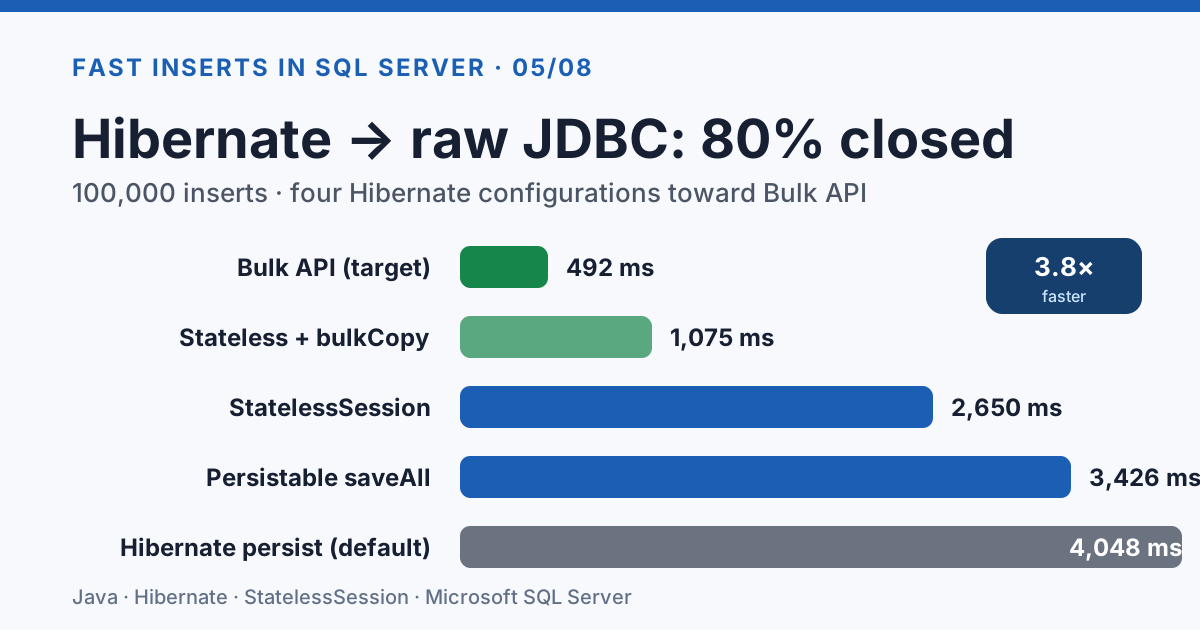
Three settings close 80% of the gap: implement Persistable to kill the pre-INSERT SELECTs
(8x faster saveAll), use StatelessSession to drop the first-level cache (35% faster persist), and
layer useBulkCopyForBatchInsert=true on top (another 2–2.5x). Combined with proper batch sizing,
this is as fast as Hibernate gets.
The saveAll Problem: SELECT Before INSERT
When you call repository.saveAll(entities), Spring Data JPA checks each entity's ID. If the ID is
non-null, it assumes the entity might already exist and calls EntityManager.merge() — which issues
a SELECT before the INSERT. For 100,000 entities, that's 100,000 extra SELECTs.
Fix: Implement Persistable
The fix is simple: make your entity implement Persistable<T> and always return true from
isNew():
 1@Entity
 2@Table(name = "person")
 3public class PersistablePerson implements Persistable<Integer> {
 4    @Id
 5    private int personId;
 6    private String userName;
 7    private String firstName;
 8    private String lastName;
 9    private int years;
10
11    @Transient
12    private boolean isNew = true;
13
14    @Override
15    public Integer getId() { return personId; }
16
17    @Override
18    public boolean isNew() { return isNew; }
19
20    @PostPersist
21    @PostLoad
22    void markNotNew() { this.isNew = false; }
23}
When isNew() returns true, Spring Data uses persist() (direct INSERT) instead of merge()
(SELECT + INSERT). The @PostPersist and @PostLoad callbacks reset the flag after the entity is
saved or loaded from the database.
Results
| Strategy | 100k persons (avg ms) |
|---|---|
| saveAll (original, Part 1) | 27,794 |
| saveAll + Persistable | 3,426 |
| persist in chunks (Part 1) | 4,048 |
Persistable makes saveAll 8x faster — and now slightly faster than manual persist-in-chunks! The SELECT elimination is the single biggest win.
StatelessSession: Bare-Metal Hibernate
Hibernate's StatelessSession is designed for bulk operations. It bypasses:
- First-level cache — no entity state tracking, constant memory
- Dirty checking — no scanning managed entities at flush time
- Cascading — related entities must be inserted explicitly
 1@Repository
 2public class StatelessSessionInsertRepository {
 3    private final EntityManagerFactory entityManagerFactory;
 4
 5    public void insertStateless(List<Person> people, int batchSize) {
 6        SessionFactory sf = entityManagerFactory.unwrap(SessionFactory.class);
 7
 8        try (StatelessSession session = sf.openStatelessSession()) {
 9            session.getTransaction().begin();
10            session.doWork(conn -> conn.createStatement().execute("SET NOCOUNT ON"));
11
12            for (int i = 0; i < people.size(); i++) {
13                session.insert(people.get(i));
14            }
15
16            session.getTransaction().commit();
17        }
18    }
19}
Results
| Strategy | 100k persons (avg ms) |
|---|---|
| Hibernate persist (Part 1) | 4,048 |
| StatelessSession | 2,650 |
| JDBC PreparedStatement (Part 2) | 2,423 |
| JdbcTemplate (Part 2) | 2,985 |
StatelessSession is 35% faster than regular Hibernate persist and within striking distance of raw JDBC. The remaining gap (~10%) is Hibernate's SQL generation and parameter binding overhead.
The Killer Combo: StatelessSession + useBulkCopyForBatchInsert
Remember the useBulkCopyForBatchInsert=true connection string parameter from
Part 4? It transparently converts PreparedStatement
batches to SQL Server's Bulk Copy protocol. It works with StatelessSession too:
| Strategy | Normal | bulkCopy=true | Speedup |
|---|---|---|---|
| Hibernate persist | 4,048 | 2,144 | 1.9x |
| StatelessSession | 2,650 | 1,075 | 2.5x |
| JdbcTemplate | 3,089 | 1,373 | 2.3x |
| Plain JDBC | 3,953 | 1,516 | 2.6x |
StatelessSession + bulkCopy=true = 1,075ms — that's just 2x slower than the raw Bulk API (492ms), while still using Hibernate's mapping metadata. For applications that need ORM convenience with near-JDBC performance, this is the sweet spot.
provider_disables_autocommit
The hibernate.connection.provider_disables_autocommit setting tells Hibernate that the connection
pool already disabled auto-commit, skipping the setAutoCommit(false) JDBC round-trip per
transaction. To use it, you need both:
1spring.jpa.properties.hibernate.connection.provider_disables_autocommit=true
2spring.datasource.hikari.auto-commit=false
| Strategy | Normal | +noAutoCommit | Speedup |
|---|---|---|---|
| Hibernate persist | 4,048 | 4,094 | None |
| Persistable saveAll | 3,426 | 2,956 | 14% |
Verdict: negligible for persist, modest for saveAll. The saved round-trip is only measurable when there are many small transactions (saveAll with frequent flushes) rather than one large batch (persist). Not worth the configuration complexity unless you have a very specific transactional pattern.
Batch Size Sweet Spot
Parts 1-4 tested batch sizes of 10, 100, 1000, and 5000. A fine-grained sweep (50-2000 in steps of 50) reveals the actual inflection points:
Bulk API
| Batch | Avg ms | Batch | Avg ms | |
|---|---|---|---|---|
| 50 | 4,565 | 600 | 834 | |
| 100 | 3,119 | 800 | 1,194 | |
| 200 | 1,874 | 1000 | 1,099 | |
| 400 | 1,196 | 1400 | 675 | |
| 500 | 980 | 2000 | 618 |
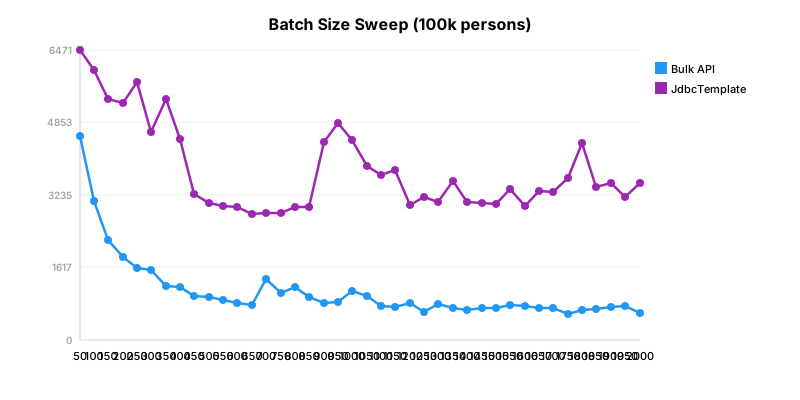
Bulk API: diminishing returns past 500. The sweet spot is 500-2000 with wide variance (single-run noise). Use 1000 as a safe default.
JdbcTemplate
| Batch | Avg ms | Batch | Avg ms | |
|---|---|---|---|---|
| 50 | 6,471 | 600 | 2,989 | |
| 100 | 6,036 | 700 | 2,847 | |
| 200 | 5,291 | 800 | 2,975 | |
| 500 | 3,062 | 1600 | 2,996 |
JdbcTemplate: optimal at 700, with minimal improvement past 500. Larger batches (1000+) don't help because the driver's TCP buffer and SQL Server's batch processing saturate around 500-800 rows.
Multi-Value Sweet Spot
Part 3 showed that multi-value INSERT
(objectsPerInsert > 1) is much faster than single-row inserts. But what's the optimal value?
A fine-grained sweep reveals:
| objectsPerInsert | Avg ms | vs single-row |
|---|---|---|
| 1 | 3,984 | — |
| 10 | 1,711 | 2.3x faster |
| 50 | 1,038 | 3.8x |
| 100 | 983 | 4.1x |
| 200 | 828 | 4.8x fastest |
| 300 | 1,033 | 3.9x |
| 400 | 1,360 | 2.9x |
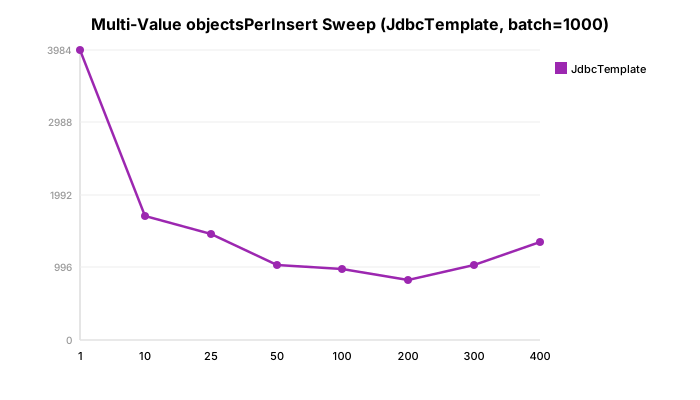
Optimal: 200 values per INSERT. After 200, SQL Server's query parser overhead for the growing SQL string outweighs the network round-trip savings. The sweet spot is 100-200 — enough to amortize per-statement overhead without overwhelming the parser.
Remember: SQL Server's maximum parameter count is 2,100. With 5 columns per row,
objectsPerInsert cannot exceed 420 (2100/5 = 420).
Connection String: sendStringParametersAsUnicode
Setting sendStringParametersAsUnicode=false in the JDBC URL tells the driver to send string
parameters as VARCHAR instead of NVARCHAR. This can help when your table has VARCHAR columns
(avoids implicit conversion), but has no effect on NVARCHAR columns:
| Strategy | Unicode (default) | sendStringParametersAsUnicode=false |
|---|---|---|
| Bulk API | 691ms | 812ms (no improvement) |
| JdbcTemplate | 3,699ms | 3,892ms (no improvement) |
If your columns are NVARCHAR, skip this setting.
Transaction Patterns
How you structure transactions matters more than how big they are:
| Pattern | 100k rows (avg ms) | Notes |
|---|---|---|
| One large transaction (commit at end) | 3,773 | Baseline |
| Commit per batch (every 1000 rows) | 3,543 | Marginally faster |
| Savepoints per batch | 3,949 | Slightly slower (overhead) |
| Auto-commit per row (10k rows only) | 5,198 ms for 10k rows (~52,000ms extrapolated) | 15x slower |
Verdict: auto-commit per row is catastrophic — each INSERT becomes its own transaction with its own log flush. Any explicit transaction (batched or whole-run) is dramatically faster. The difference between commit-per-batch and commit-at-end is noise.
Isolation Levels
| Isolation | 100k rows (avg ms) |
|---|---|
| READ_UNCOMMITTED | 3,189 |
| READ_COMMITTED (default) | 3,037 |
| SERIALIZABLE | 2,963 |
Isolation level has no measurable impact on INSERT-only workloads. The isolation level primarily affects reads and locking behavior — there's nothing for an INSERT to "read dirtily" or "serialize against". Don't bother tuning isolation level for bulk-load performance.
GC and JVM Memory Tuning
Does the Java garbage collector affect database insert throughput? We ran the same test with four GC/heap configurations:
| GC | Heap | Bulk API (ms) | JdbcTemplate (ms) | Total GC pause |
|---|---|---|---|---|
| G1 (default) | 512 MB | 687 | 3,194 | ~59-138 ms |
| G1 | 4 GB | 762 | 3,095 | ~93-139 ms |
| Parallel | 2 GB | 863 | 3,401 | ~21-59 ms |
| ZGC | 4 GB | 867 | 3,291 | ~109-315 ms |
GC choice has essentially no impact on insert performance for this workload. The reasons:
- Short-lived objects fit in young generation —
Personinstances die quickly after being batched and sent to the driver. All GCs handle this well. - GC pauses are tiny compared to database I/O (300ms of GC vs 30+ seconds of total time).
- ZGC has slight overhead — its concurrent collection isn't needed when heap pressure is low.
Takeaway: stick with the default G1 and modest heap size (512 MB-1 GB is enough for 100k-row batches). Over-tuning the JVM for database workloads is a waste of time — the bottleneck is the network/disk, not Java.

The one thing to remember
StatelessSession +
useBulkCopyForBatchInsert=true= 1,075 ms for 100k inserts — 2x slower than raw Bulk Copy (492 ms), with ORM mapping metadata still working for you. If you need Hibernate's convenience without paying Hibernate's full price, that's the combination.
If you can only make one change to speed up a saveAll() call: implement Persistable<T> with
isNew = true. It eliminates the pre-INSERT SELECTs and makes saveAll 8x faster — a 10-line
code change for a 10x result.
Next: Part 6 — Parallel Inserts splits the data across multiple connections to see how far parallel threads can push it.