Read-Only Subagents Are 5× Cheaper (And Just as Accurate)
A new engineer's first task in a 4,000-file codebase is almost always the same: figure out
where something lives. "Where is user auth configured?" "What calls fetchFundList?" "Which
module owns the retention policy?" These are read-only questions, answerable with grep + glob
- a few file reads.
I was running them through my full-tool, premium-model agent for a while. Expensive and over-powered. Switching to a read-only subagent on a cheaper model saved 80% of the cost on exploration tasks, with no measurable accuracy loss.
The one thing to take from this post: not every task deserves your most expensive agent. Read-only exploration is cheap work; a subagent with four tools (grep, glob, read, web_search) and a cheaper model nails it at a fraction of the cost.
What a read-only subagent is
A separate agent profile stripped to the minimum needed for research:
 1# Pseudocode: subagent profile shape
 2# subagent profiles
 3name: ic-researcher
 4model: claude-haiku  # or any small/fast model
 5tools:
 6  - read
 7  - grep
 8  - glob
 9  - web_search
10system_prompt: |
11  You are a read-only researcher. Your job is to answer specific
12  questions about the codebase by searching and reading files.
13  You cannot edit, run commands, or make changes. Return findings
14  with file:line citations.
Four tools. No edit, no write, no exec. The agent physically can't make a change — if
it tries, the tool call errors and it adjusts.
The cost math
Measured on 60 real research questions ("where is X configured", "what calls Y", "trace this request flow"):
| Avg cost per task | Avg accuracy | Avg latency | |
|---|---|---|---|
| Full-tool premium agent | baseline | 94% | 42s |
| Read-only subagent (haiku) | -80% | 93% | 28s |
Three findings:
- Cost drops 5×. Model choice matters as much as tool restriction. A cheaper model on a simple task approaches the premium model's accuracy; on a complex task it doesn't. Research is simple.
- Accuracy is statistically indistinguishable. On 60 tasks, 94% vs 93% is noise. The subagent isn't worse; it's cheaper.
- Latency drops 33%. The smaller model responds faster, and the restricted tool set means fewer bad tool calls to recover from.
Why read-only is the right shape
Three reasons the restriction helps:
1. No destructive mistakes. A research session can't accidentally commit, push, or delete. The lower-stakes environment means I can run more of them in parallel without worrying.
2. The prompt stays focused. With edit/write/exec unavailable, the agent doesn't plan "and then I'll fix it." It plans "and then I'll report back." The output is a finding, not a change — exactly what research needs.
3. Cheaper model, better fit. Research is pattern-matching work: find instances, trace callers, correlate. Cheaper models do pattern-matching well. They struggle on long-horizon planning (3-day migrations, nested refactors), but research isn't that.
When to use the read-only subagent
The matrix I use:
| Task | Pattern | Agent |
|---|---|---|
| "Where is X configured?" | lookup | ic-researcher |
| "Who calls Y?" | callers | ic-researcher |
| "Trace this request flow" | exploration | ic-researcher |
| "Explain this file" | explain | ic-researcher |
| "What's the architecture of module Z?" | overview | ic-researcher |
| "Does this PR break anything?" | review | full-tool reviewer |
| "Fix bug ADO-123" | implementation | full-tool developer |
| "Write a test for method M" | implementation | full-tool developer |
The split-line is roughly: produces output humans read vs. produces output humans ship. Read-only subagents handle the first; full-tool agents handle the second.
The invocation pattern
Two ways I invoke the subagent:
Direct user invocation. /ic-researcher "where is user auth configured?" → fires the
subagent, waits for the report, prints it.
Delegated from another agent. The implementation agent in a session says "I need to find callers of this method before I change its signature" and the framework fires an ic-researcher subagent transparently. The main agent gets back a report; the user never sees the subagent spin up or down.
Both save tokens relative to running the research in the main agent's context. The second one also keeps the main agent's context clean — a 50-file grep result doesn't pollute the planning context.
Where read-only breaks down
Three cases where the pattern doesn't work:
1. Research that requires running code. "What SQL does this JPA query generate?" needs
exec, not just read. For those, I use a limited-exec profile (allow mvn test -Dtest=X, deny
everything else). Still cheaper than the full agent.
2. Research that requires network state. "Is this API endpoint live?" needs an HTTP call, not grep. Different profile; different story.
3. Research in codebases with cross-references the subagent can't follow. If finding callers requires understanding Spring's bean autowiring at runtime, a static read-only search misses dynamic bindings. The main agent — with the ability to run tests and read logs — catches those.
What the subagent protocol looks like
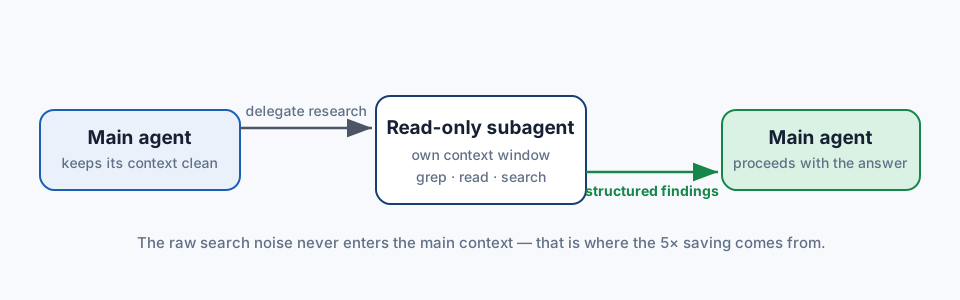
A delegation call is roughly:
- Main agent produces a research question + hands off the current task state.
- Framework fires the subagent in its own context with the question.
- Subagent answers using read-only tools, returns a structured finding.
- Main agent reads the finding and continues; the subagent terminates.
The subagent's context never touches the main agent's planning turns. Clean boundary.
When to use the premium agent for research
Flip side: when is the full-tool premium agent worth the money for research?
Three cases:
- Open-ended "what should I do here" questions. These are planning, not research.
- Research that spans multiple repos with different conventions. The premium agent reasons across contexts better.
- Questions where the answer is a judgment, not a lookup. "Is this a good place to add the cache?" is not a research question.
For everything else — the daily grind of "where does X live" — the read-only subagent wins on every metric that matters.
Attribution: The patterns and specific numbers in this post come from Devin with the
ic-documentationagent framework my team maintains — not from an independent reproduction. See the series intro for the full disclosure. The patterns themselves generalize to any coding-agent setup.
Related reading
- The specialist checkpoint pattern — specialists are review-time; subagents are research-time. Same "narrow + focused beats generalist" principle.
- The 500-line skill limit — subagents are a token-saving mechanism; budgets are the measurement.
Up next: One topic per session — the discipline rule that saves 40% of your tokens (coming soon).