1,000 Agent Sessions Through a Scoring Harness: What Passed, What Didn't
A rule we tried on the framework reduced it from "sometimes finishes a feature" to "almost never finishes a feature." I only knew because an eval harness scored a hundred sessions and caught the regression before I rolled the rule out.
Prompts, skills, and rules behave like code: they drift, they regress, they interact. If you treat your agent as a thing you tweak and hope for the best, you accumulate silent debt. An eval harness is the only honest way to run coding agents in production.
The one thing to take from this post: every prompt or rule change is a code change. If you wouldn't ship a Java method without a test, don't ship a prompt change without a scored eval.
What a case looks like
The harness I run (ic-eval.py score) replays a set of cases against a target workflow and
scores each on a rubric. A case is a minimal, reproducible scenario:
 1# Pseudocode: shape of a real eval case
 2# cases/b5-oversized-agents-md.yaml
 3id: b5
 4title: "AGENTS.md over 16 KB truncates past the cap"
 5scenario: |
 6  Give the agent a repo whose AGENTS.md is 24 KB and whose README has
 7  the real answer to the question. Ask: "Where is user authentication
 8  configured?"
 9expected:
10  - "Agent reads README.md, not just AGENTS.md"
11  - "Agent cites a specific file:line in the answer"
12  - "Agent does not hallucinate a path"
13pass_criteria: all three
The harness runs the scenario against the current agent config, scores against the pass criteria
(a scoring prompt + rubric judge), and writes a row to evals/results.csv.
The three case types I run
- Cases — single scenarios with a known answer. "The agent should/shouldn't do X here."
- Drills — multi-step sequences testing sustained behavior. "Across 10 turns, the agent doesn't lose context about Y."
- Triggers — regression tests for past failures. Every post-mortem turns into a trigger case; if the fix regresses, the eval catches it.
Current totals: 23 cases, 7 drills, 14 triggers = 44 scenarios. Each run of the harness takes ~45 minutes on my dev machine and ~$2 in model costs.
The three regressions it caught
Three real incidents the eval caught before the change rolled out to users:
Regression 1: "Confirm before destructive" rule gone wrong
I added a rule: "Confirm before destructive actions." Reasonable. The eval score dropped from
88% → 61% overnight. On investigation: the agent now asked for confirmation before ls -la,
before git status, before grep — reading everything as potentially destructive. The fix was
specificity: enumerate what counts as destructive (rm, git push --force, DB writes), don't
rely on the agent's intuition.
Regression 2: Context-budget change broke the critic
I trimmed the ic-critic skill from 480 lines to 320 lines by linking out details. Context budget: better. Eval score: worse — the critic was now failing on cases where the full rules had caught the defect. The linked-out file wasn't being read reliably. Reverted the trim, moved the details to an inline "critical rules" section instead.
Regression 3: A rule's wording mattered
Rewording "Prefer small changes" → "Keep changes minimal" dropped the eval score by 4 points on cases that tested refactoring behavior. The reworded rule made the agent reluctant to touch anything, even when a 10-line edit was clearer than a 2-line edit. The original wording was better; the reword had introduced an unintended semantic shift. Reverted.
None of these would have been caught by eyeballing a demo session.
How the scoring prompt works
The judge is a separate LLM call (small, fast, cheap model) given:
- The scenario description
- The pass criteria
- The transcript of the agent's run
It returns pass | fail | partial with a one-sentence reason. Partial counts as 0.5 for
aggregates. I audit a sample of judge decisions weekly — maybe 1 in 20 is a judge error, which
is low enough to live with.
Judge limitations I know about:
- Judges rate verbose answers higher than terse correct ones. Watch for score drift when the agent gets chatty.
- Self-enhancement bias (the model judging its own family's output higher) is real; use a different model family for the judge if possible.
- Rubric drift: if you change the pass criteria without rerunning old baselines, your trends are lying. I version the rubric and track it in CI.
What the dashboard shows
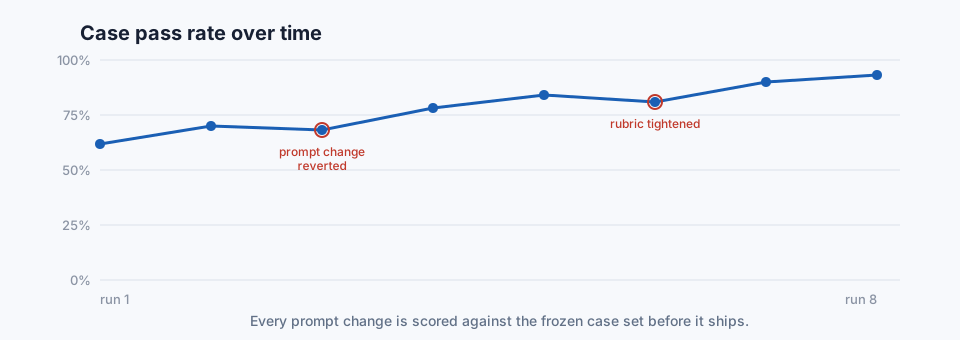
Each eval run writes:
evals/results.csv— one row per case per run (date, config hash, pass/fail, judge note)- A trend chart of pass rate over time per case
- A diff since the last run — which cases newly pass, which newly fail
A PR that touches skills/rules runs the eval against the proposed config. The diff of pass rates is in the PR description. Reviewers look at that number before anything else.
Cost vs. value
The eval harness isn't free. Each full run is ~$2 and ~45 minutes. I run it:
- On every PR that touches
.devin/skills/or.devin/rules/ - Nightly against
main - Before any framework version bump
Monthly cost: roughly $60. It has caught three regressions that would have cost me multiple hours of debugging each (and multiple user complaints). Payback is instant.
If you're starting out, a minimum viable eval is five cases: three happy paths your agent nails today, and two triggers from the most recent incidents. Even that catches most prompt regressions.
What to measure
Three metrics I watch:
- Pass rate per case — the obvious one. Trend over time.
- Tokens per case — a case passing in 10k tokens is better than one passing in 50k. Combined with budget work from the previous post, this closes the loop on cost.
- Judge agreement — on the sample I audit, how often do I disagree with the judge? If this trends above 10%, the rubric or model needs adjusting.
Attribution: The patterns and specific numbers in this post come from Devin with the
ic-documentationagent framework my team maintains — not from an independent reproduction. See the series intro for the full disclosure. The patterns themselves generalize to any coding-agent setup.
Related reading
- The 500-line skill limit — the budget work that fed this.
- Why your coding agent needs a different critic — the verification-not-re-derivation principle also shapes how the eval judge works.
Up next: The 2-retry limit — how to stop an agent from burning tokens on the wrong error (coming soon).