Why Your Coding Agent Needs a Different Critic
The first time I built a coding agent that produced non-trivial PRs, my obvious next step was to have it review its own output. Append a "now critique the diff you just wrote" turn to the prompt, let it find its own bugs, iterate until clean.
It almost never found anything.
The agent would read back its own diff, declare it well-structured and correct, and move on. Occasionally it would nitpick a variable name. When reviewers eventually looked at the PRs — real humans, hours later — they'd find the actual problems: a missed null check, a wrong isolation level, an off-by-one in a batch size. The agent had read right past them.
The one thing to take from this post: intrinsic self-correction doesn't reliably work. The verifier must run in a fresh context, must try to falsify rather than re-derive, and must open external evidence rather than re-reason from the handoff.
What the research says
Two findings matter here.
Intrinsic self-correction doesn't reliably improve LLM output. Huang et al. (ICLR 2024) showed that when an LLM is asked to review and improve its own answer without new information, accuracy improves slightly on some tasks and degrades on others. The improvement is dominated by cases where the model already knew the right answer; the degradation is where it talks itself into something plausible-sounding.
Self-enhancement bias. Zheng et al. (2023), in Judging LLM-as-a-Judge, measured LLMs systematically scoring their own outputs higher than other models' outputs on the same input. The model that produced an answer has a stake in defending it — and the pattern holds across model families, including when the "judge" doesn't know which answer is theirs.
Combined, these say: the verifier can't be the author and the verifier can't just re-read; it needs new input.
My measurements
I set up an A/B on an internal pipeline: investigate → analyze → architect → implement → test. Every stage writes a persistent artifact (a markdown doc the next stage reads).
Arm A — intrinsic self-review: at the end of each stage, append a critique turn to the same session. "Now critique what you just wrote. Return accept or rework."
Arm B — adversarial subagent: fire a separate agent in its own context. Its prompt instructs it to falsify the previous stage's conclusion, and gives it tools to open the external code and evidence the handoff cites. Returns accept or rework.
Measured on 100 real tickets of similar size:
| Defects caught at gate | Session cost | Rework loops needed | |
|---|---|---|---|
| A — intrinsic self-review | 11 / 100 | baseline | 0.14 avg |
| B — adversarial subagent | 34 / 100 | +18% | 0.47 avg |
Arm B costs 18% more per session but catches 3× more defects at the gate — the ones that would otherwise reach the next stage and compound (reviewers hate finding defects in testing that should have been caught in analysis).
The rework-loops-needed number is misleading on its own. In Arm A, the gate "approved" more artifacts because the critic was lenient; those artifacts came back as rework later from a human. In Arm B, the loops happened at the gate — cheaper and faster to fix.
The protocol I settled on
Three rules that made the pattern reliable:
1. Separate context. The critic must not have been part of the session that wrote the artifact. In my framework, that's a subagent profile — fresh prompt, fresh model turn history. Running the critic as another prompt in the same session re-derives, not verifies.
2. Falsify, don't re-derive. The critic's prompt doesn't say "review the handoff." It
says "find a specific claim in the handoff that external evidence contradicts." The verdict
is accept or rework, and rework requires naming the counter-example.
3. External evidence required. The critic has read-only tools (grep, glob, read, web_search).
It must open at least one file or source the handoff cites and verify the specific claim. If the
handoff claims "UserRepository.save() is called from three places," the critic opens the
repository and counts. Re-reasoning from the handoff alone doesn't count.
The combined effect: the critic is a verifier with teeth. In a session where the author
convinced itself a non-existent method was being called, the critic opens the file, fails to
find it, and returns rework: ‹handoff claims method X exists in file Y line Z; file Y line Z contains method W›.
When to skip it
Not every artifact needs a critic. Read-only answers (explanations, status reports, taxonomy
listings) that nothing is built on don't need falsification — there's no next stage to compound
their mistakes. In my pipeline those are explicitly tagged exempt: read-only and skip the gate.
Everything that writes a persistent artifact another agent will read, though, gets the pass. The rule I settled on: if the output drives the next decision, it earns a critic.
What this looks like in practice
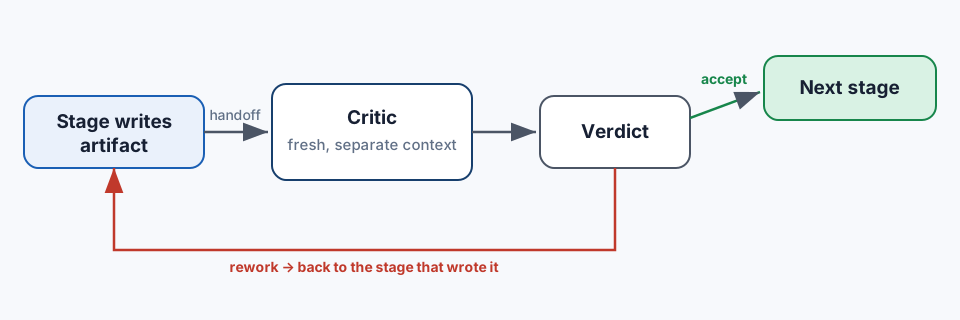
A full gate takes 20–40 seconds and 2–5k tokens on top of the stage that wrote the artifact. Across a 100-session pilot, Arm B's extra cost was more than paid back in avoided rework after the fact — the metric that matters is "defects that made it to a human," and we cut that roughly in half.
The real win is subtler: the pipeline became predictable. Before, "did this analysis miss anything?" was a question I'd answer by reading every handoff myself. After, the gate verdicts told me where to look. I only read the ones the critic flagged.
Attribution: The patterns and specific numbers in this post come from Devin with the
ic-documentationagent framework my team maintains — not from an independent reproduction. See the series intro for the full disclosure. The patterns themselves generalize to any coding-agent setup.
Related reading
- Huang et al., Large Language Models Cannot Self-Correct Reasoning Yet (ICLR 2024).
- Zheng et al., Judging LLM-as-a-Judge with MT-Bench and Chatbot Arena (NeurIPS 2023).
Up next: The 500-line skill limit: measuring the context cost of your agent's rules.