The 500-Line Skill Limit: Measuring Your Agent's Context Cost
Every rule in your agent's prompt costs tokens on every single turn for the rest of the session. Add a 300-line skill, and a 20-turn session pays for 20 copies of that skill. Add a 900-line AGENTS.md, and every project session that touches the repo opens with that 900-line prelude burned into the context window.
I ran a context-budget audit on my framework six months in. The results scared me enough to build CI that fails on drift.
The one thing to take from this post: if you can't tell me how many tokens your agent's rule set costs per session, you can't optimize anything downstream of it. Measure first.
What the budget looked like before
My framework at the time: ~70 registered skills, each a markdown file loaded on activation. Most skills were "just a few extra lines" at a time. The audit:
| Component | Size | Loaded when |
|---|---|---|
| Global AGENTS.md | 11.3 KB | every session, every repo |
| Project AGENTS.md | ~9 KB avg | per repo, every session |
| Framework system prompt | 42 KB | every session |
| Registered skills (70 × ~400 lines avg) | 1,900 KB total | on activation |
Rules (.devin/rules/*.md) | 28 KB | every session |
The number I didn't want to see: the top 10 skills alone averaged 712 lines each. A medium session that activated 4 skills was starting out ~15,000 tokens in before the user said hello.
For context: a session that spent $0.12 was spending $0.04–$0.06 on the preamble alone, before any work got done. Multiply by thousands of sessions per month across a team.
The script that made the pain visible
I wrote a Python budget script (context-budget.py) that counts tokens per file using
tiktoken, groups by category, and emits a context-budget.md report:
1# Pseudocode (simplified from the real framework script)
2def budget(root: Path) -> dict:
3    enc = tiktoken.get_encoding("cl100k_base")
4    totals = defaultdict(int)
5    for path in root.rglob("*.md"):
6        category = categorize(path)  # skill | rule | agents-md | docs
7        totals[category] += len(enc.encode(path.read_text()))
8    return totals
The report sorts files by token cost. Opening it for the first time was the moment I realized the top three skills accounted for a quarter of total skill tokens. Two of them hadn't been touched in three months.
The limits that actually work
the framework sets three hard caps, enforced in CI:
1. AGENTS.md ≤ 16 KB. Hugo/Devin truncates the global AGENTS.md past 16 KB — details past that point just don't get seen by the agent. If a repo's AGENTS.md is approaching the cap, move detail into linked files. CI fails on files over.
2. Any single skill ≤ 500 lines. Longer skills become hard to maintain and expensive to load.
If a skill grows past 500 lines, split it: core instructions in SKILL.md, bulky references in
a references/ subdirectory loaded only when needed.
3. Context budget tracked per PR. The budget script writes docs/context-budget.md in CI
and fails the build if any category grew more than 5% without an explicit BUDGET-INCREASE: …
annotation in the PR description. A rule added casually gets caught at review time.
What I actually trimmed
The audit's top findings, with the fixes:
- Three skills had copy-pasted versions of the same 180-line "coding standards" section. Consolidated into one canonical file; the three skills link to it. Savings: ~360 lines × tokens per session where any of the three activated.
- An 800-line AGENTS.md had an exhaustive module-by-module index. Moved to
docs/compact-index.md; AGENTS.md now says "for the full index, read X." Savings: dropped AGENTS.md from 23 KB to 8 KB. - A "troubleshooting" skill was never activated — I'd forgotten I built it. Deleted.
- A skill that fired on every git operation included 300 lines of git etiquette most of which overlapped with the global rules. Trimmed to 90 lines of the delta.
Total: a 36% reduction in average session preamble tokens over three weeks.
The before/after on real sessions
I replayed 50 recent sessions through both configurations and measured total tokens consumed. Same prompts, same tasks, different preamble weight:
| Session type | Before (K tokens) | After (K tokens) | Reduction |
|---|---|---|---|
| Quick explain (3-5 turns) | 14 | 9 | -36% |
| Bug fix (10-15 turns) | 48 | 33 | -31% |
| Full SDLC pipeline (30+ turns) | 142 | 101 | -29% |
The savings don't look dramatic per session. Multiplied by my team's throughput — a few hundred sessions a week — it's a line item on the cost dashboard that finally stopped climbing.
When to break the limits
The limits are defaults, not laws. Two legitimate exceptions I accept:
Security rules. The security skill is longer than 500 lines because it enumerates specific threat patterns with examples. Agents cutting corners on security are expensive in a different way than tokens.
Framework boot sequence. The skill that teaches a new agent how the framework works is
long because it has to be — a half-trained agent breaks more than it fixes. The exception is
annotated in CI with BUDGET-EXEMPTION: boot-sequence (critical path).
Both exceptions are named. Nothing else gets a pass.
What the dashboard looks like now
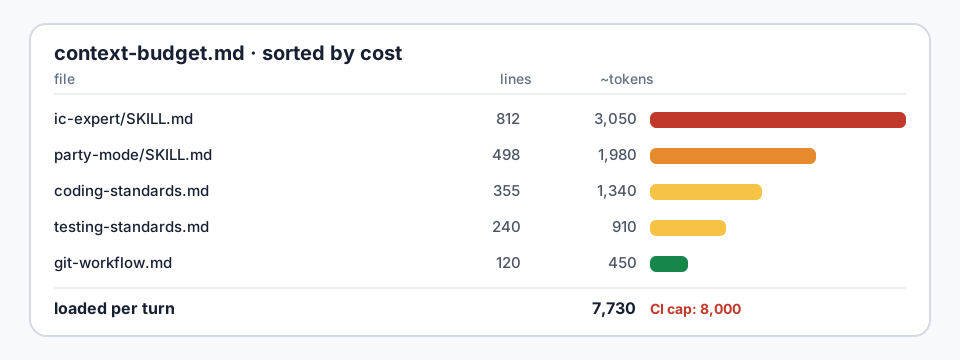
Every PR touching skills or rules shows a context-budget diff in the review. If it's negative (cheaper), we celebrate briefly. If it's positive, the author explains why — in the PR description, not after the fact. Four months in, nobody has quietly bloated a skill in a way the tooling didn't catch.
The practice has a secondary effect: we delete more. A skill that hasn't earned its tokens
gets a remove-skill PR. Deleting is cheap when the cost is visible; invisible, it stays.
Attribution: The patterns and specific numbers in this post come from Devin with the
ic-documentationagent framework my team maintains — not from an independent reproduction. See the series intro for the full disclosure. The patterns themselves generalize to any coding-agent setup.
Up next: I ran 1,000 agent sessions through a scoring harness — the eval methodology, the regressions caught, and the dumb rule tweaks that broke things.